Future of Freight: How Electric Trucks, AI and Autonomous Technology Are Transforming Logistics

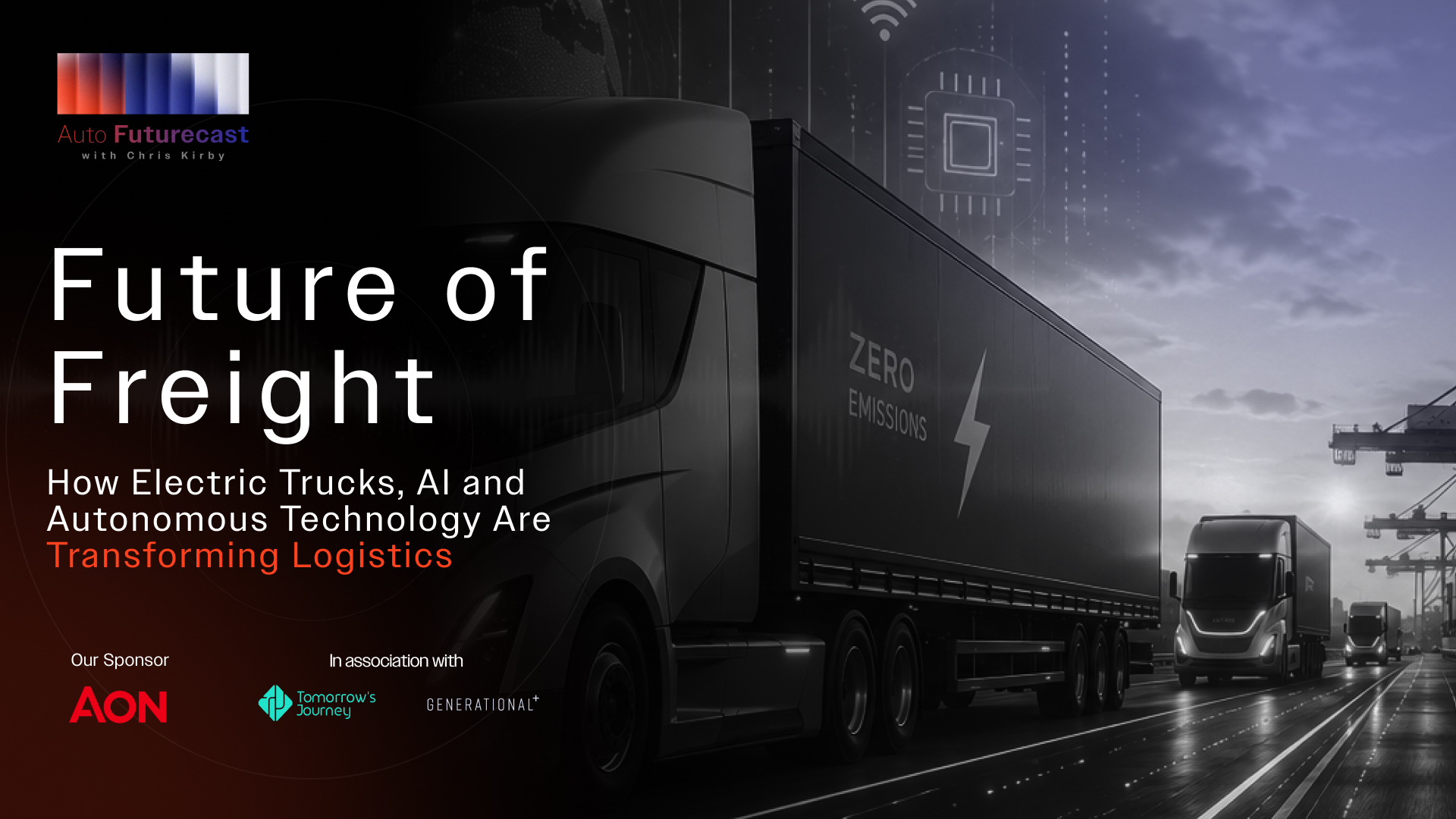
The future of freight is being shaped by far more than the transition from diesel to electric trucks. Fleet electrification, charging infrastructure, artificial intelligence, automation and new operating models are beginning to change how logistics businesses think about vehicles, energy and the movement of goods. What initially looks like a vehicle transition is quickly becoming a much broader transformation of the entire freight ecosystem.
In Episode 4 of Auto Futurecast Season 2, Tomorrow’s Journey CEO Chris Kirby sits down with Jamie Sands, Head of Solutions at Welch’s Transport, to explore what this transformation looks like from inside the freight industry. Jamie’s role spans technology, innovation and sustainability, giving him a practical view of what happens when emerging technologies meet the everyday realities of running a logistics operation.
The conversation reveals an important point about the future of freight: electrification may be one of the most visible signs of change, but the bigger opportunity lies in rethinking the systems around the vehicle. From where trucks charge and how businesses calculate total cost of ownership to how AI uses fleet data and how autonomous vehicles could reshape logistics networks, every part of the industry is becoming increasingly connected.
What Is Driving the Future of Freight?
The future of freight is being driven by the convergence of electrification, energy, data, artificial intelligence and automation. For decades, the basic commercial vehicle model remained relatively consistent. Operators bought diesel trucks, fuelled them through an established network and optimised their operations around variables the industry understood well. Electric HGVs introduce a different equation because the vehicle can no longer be considered separately from the energy and infrastructure required to operate it.
Jamie points out that commercial vehicles are also fundamentally different from passenger cars because the decision to electrify is much less emotional. A fleet operator ultimately needs to know whether a vehicle can perform the required job and whether the economics make sense.
That changes the nature of the EV conversation. Instead of simply asking whether businesses want electric trucks, operators need to understand whether they can complete the required routes, what happens to payload, where vehicles will charge, how much that energy will cost and how the economics compare over the lifetime of the asset. Answering those questions requires businesses to look beyond the truck itself and consider the entire operational system around it.
Why Does Fleet Electrification Require a New Business Case?
Fleet electrification requires businesses to rethink total cost of ownership because energy, charging infrastructure and operations are becoming increasingly important parts of vehicle economics. Simply comparing the purchase price and running costs of an electric HGV with a diesel equivalent can miss some of the biggest opportunities created by the transition.
One of Jamie's most memorable observations during the conversation is: “Your dad’s total cost ownership calculator doesn’t work anymore.” His point is that if operators apply exactly the same calculations they have traditionally used for diesel fleets, the business case for electrification may not make sense. Once energy and the wider operating model are brought into the equation, however, the economics can begin to look very different.
That means fleet electrification isn't simply a procurement decision. Businesses increasingly need to consider the cost of energy, when and where vehicles charge, infrastructure investment, utilisation and how electric vehicles interact with the rest of the fleet. Electrification therefore becomes an energy strategy, infrastructure strategy and operational strategyas much as a vehicle strategy.
For businesses preparing for the future of freight, this broader perspective will be essential. The winners may not simply be those that secure electric vehicles first, but those that understand how to redesign their operations around them.
Are Range and Payload Really the Biggest Problems for Electric Trucks?
Range and payload remain genuine challenges for electric HGVs, but Jamie argues that both need to be considered in the context of how freight networks actually operate. Batteries add weight, potentially reducing the amount a vehicle can carry, while range naturally determines which routes can currently be electrified. However, treating those limitations as fixed barriers can oversimplify the problem.
Jamie points out that around a third of freight miles can be travelled empty. From that perspective, payload becomes partly an optimisation challenge, rather than solely a limitation of battery technology. If operators can improve how vehicles, loads and routes are coordinated across the network, some of the impact can potentially be addressed operationally.
Range presents another interesting difference between passenger and commercial vehicles. Truck drivers already operate within regulated driving and rest periods, which means there are existing stops within a commercial journey. The opportunity is therefore to align those mandatory breaks with charging wherever possible.
This changes the question from “Can an electric truck travel as far as a diesel truck without stopping?” to “Can we put the required energy into the vehicle during the stops that already exist?” As Jamie summarises during the episode, “It becomes an infrastructure game rather than a vehicle.”
Why Is EV Charging Infrastructure Critical to the Future of Freight?
EV charging infrastructure could ultimately determine how quickly electric trucks scale because commercial fleets require significantly more power and more complex charging strategies than passenger vehicles. For some operations, the model may be relatively straightforward: a truck returns to the depot at the end of its shift, charges overnight and leaves again the following morning. But freight networks are rarely that simple across every vehicle and route.
Not every truck returns to the same depot each night, and not every depot has access to the grid capacity required to charge multiple electric HGVs. Jamie explains that installing commercial charging infrastructure is very different from adding a home EV charger. Significant grid upgrades may be required, while the cost and time involved can vary considerably depending on location.
As a result, the future of freight will likely require a combination of depot charging and on-route charging. Jamie discusses the possibility of using partner depots, local authority sites and dealer networks alongside more conventional charging hubs. Rather than simply recreating petrol stations for electric trucks, the industry may eventually develop a more distributed charging ecosystem that uses existing locations and infrastructure in new ways.
This is a significant infrastructure challenge, but there is also an advantage in addressing it now. The number of electric HGVs on the road remains relatively small, creating an opportunity to test different models before demand increases significantly. Jamie describes the transition as something that could happen “really, really fast” once momentum builds, making early infrastructure planning increasingly important.
How Are Electric HGVs Changing the Driver Experience?
The transition to electric HGVs isn't only changing fleet economics and infrastructure requirements. It is also changing the experience of the people who spend their working days behind the wheel.
One of the more unexpected observations in Chris and Jamie's conversation is that drivers can become some of the strongest supporters of electric vehicles. Resistance can instead come from the operational middle of a business, where teams need to manage the additional complexity associated with planning, charging and introducing a different way of working.
For drivers, the benefits can be much more immediate. Reduced noise and vibration can make a meaningful difference when someone spends hours every day inside a commercial vehicle. Jamie explains that drivers may not even realise how much those factors affect them until they move into an electric truck. Once they do, the difference becomes obvious, with drivers reporting feeling more relaxed.
It is an important reminder that the business case for new technology can contain benefits that are difficult to capture in a traditional spreadsheet. Driver experience, comfort and the wider working environment could become increasingly important parts of the conversation around fleet electrification.
How Is AI Changing Logistics and Fleet Management?
Artificial intelligence could become one of the most significant tools available to freight operators because modern logistics businesses already generate enormous quantities of data. Vehicles, planning systems, maintenance platforms, asset management tools and day-to-day operations continuously produce information, but historically much of that data has been difficult to turn into practical insight.
Jamie describes AI as potentially giving a smaller independent operator something resembling “a data scientist on the team.” That is particularly significant for businesses that may never have been able to justify employing specialist data teams but already possess huge amounts of operational information.
The opportunity is to move beyond using data simply to generate invoices or identify when a fault has already occurred. Jamie points to applications including predictive maintenance and predictive operations, where businesses can begin using their existing information to understand what is likely to happen next and make better decisions earlier.
For the logistics industry, the competitive advantage may therefore come less from who possesses the most data and more from who can turn that data into useful decisions fastest. AI could make capabilities that were previously available primarily to larger organisations increasingly accessible to independent operators.
What Role Will Autonomous Trucks Play in the Future of Freight?
Autonomous trucks could fundamentally change freight economics by increasing vehicle utilisation and allowing logistics networks to operate in ways that are difficult with today's driver-dependent model. While autonomous mobility is often discussed through the lens of robotaxis and passenger vehicles, Jamie questions why freight shouldn't be an equally important application.
His argument is straightforward: autonomous technology is already being developed to carry people, arguably the most precious and complicated cargo possible. If the technology can reach the point where society trusts it to transport passengers, moving parcels, materials and freight could become a natural application. Jamie believes that once autonomous freight begins gaining momentum, adoption could happen extremely quickly.
The bigger opportunity, however, isn't simply removing a driver from a truck. Autonomous vehicles could change how the entire freight network is orchestrated. Vehicles could potentially operate for longer periods, move between different jobs, charge when required and be utilised across different parts of a network rather than remaining tied to the operational patterns that exist today.
Jamie describes logistics as a business of marginal gains, where there is rarely a single technological “silver bullet”. Instead, operators continually look for small efficiencies across routes, vehicles, energy and utilisation. Autonomous technology combined with AI could allow those marginal gains to be optimised across a much larger system.
Could Autonomous Freight Create New Risks for Fleet Operators?
The efficiency opportunity created by autonomous freight is significant, but the transition also raises an important commercial question: who captures the value?
If freight networks increasingly depend on technology platforms to allocate jobs, manage vehicles and connect supply with demand, traditional operators could find themselves occupying a very different position in the value chain. Jamie raises the possibility that logistics businesses could eventually own the trucks, chargers and warehouses while another platform controls the customer relationship and decides where the work goes.
That could create enormous efficiencies across the wider network while simultaneously putting pressure on the margins and independence of individual operators. For freight businesses, the challenge therefore isn't simply adopting autonomous technology when it becomes available. It is participating in conversations about how the new ecosystem should work and ensuring operators have a meaningful role within it.
The technology will create value. The more difficult question is where that value ultimately flows. Waiting until autonomous networks are already established could leave independent operators with far less influence over the answer.
Why Will Collaboration Matter for the Future of Logistics?
The scale of the transformation facing freight makes collaboration increasingly important. Electric vehicles depend on energy infrastructure. AI solutions depend on high-quality operational data. Autonomous systems need to work within existing freight networks. Technology companies therefore need access to real operational environments, while operators need access to expertise and innovation they may not have internally.
Welch’s has positioned itself as what Jamie describes as a kind of industry “living lab”, allowing technologies and solutions to be tested in a genuine logistics environment. For a smaller independent operator, being more agile can actually become an advantage, making it easier to experiment with emerging technologies and work with innovation partners.
That philosophy has also contributed to the creation of 2040, a not-for-profit research organisation with a mission to accelerate the transition towards the future of freight. Jamie describes collaborative innovation as central to its approach, with operators and solution providers bringing real challenges and data into research programmes that can test potential solutions and return those learnings to the wider industry.
There is also a policy dimension. Jamie explains that independent operators need greater representation in conversations about the future of the industry. If policy, infrastructure and technology decisions are made without their involvement, the systems that emerge may not reflect the realities of the businesses expected to use them.
What Should Freight Businesses Do to Prepare for the Future?
Preparing for the future of freight requires businesses to think beyond individual technologies and consider how those technologies interact. Buying electric trucks without solving charging will not be enough. Installing charging infrastructure without understanding energy requirements and route planning will not be enough. Collecting data without turning it into useful insight will not be enough either.
The same applies to AI and autonomous technology. These tools could unlock significant efficiencies, but businesses also need to understand how they might change customer relationships, operating models and the distribution of value across the logistics ecosystem. The strategic question isn't simply “Which technology should we adopt?” but “What will our business look like when all of these technologies begin working together?”
For operators, that means understanding where electrification works today, experimenting with charging models, using existing fleet data more intelligently and collaborating with technology and infrastructure partners. Perhaps most importantly, it means participating in the development of the future rather than waiting for the industry to settle on a model and then reacting to it.
The Future of Freight Is a Systems Transformation
The future of freight isn't simply a story about replacing diesel trucks with electric trucks. It is about what happens when fleet electrification, charging infrastructure, energy, AI in logistics, autonomous trucks and new commercial models begin interacting with one another.
Each development changes another part of the equation. Electric trucks change how operators think about energy. Energy changes infrastructure requirements. Infrastructure affects routes and planning. AI changes how businesses understand their vehicles and operations. Autonomous technology could eventually change how those assets are utilised altogether.
That creates complexity, but it also creates enormous opportunity. The businesses that lead the next generation of freight may not necessarily be those that adopt every new technology first. They may instead be the organisations that understand how the pieces fit together, experiment intelligently and help shape the systems in which they will eventually operate.
As Chris Kirby and Jamie Sands explore throughout Episode 4 of Auto Futurecast, many of the biggest questions surrounding the future of freight are still being answered. That makes now one of the most important times for fleet operators, logistics businesses, technology providers and policymakers to be part of the conversation.