The Future of EV Charging: From Home Chargers to V2X and the Connected Energy Ecosystem

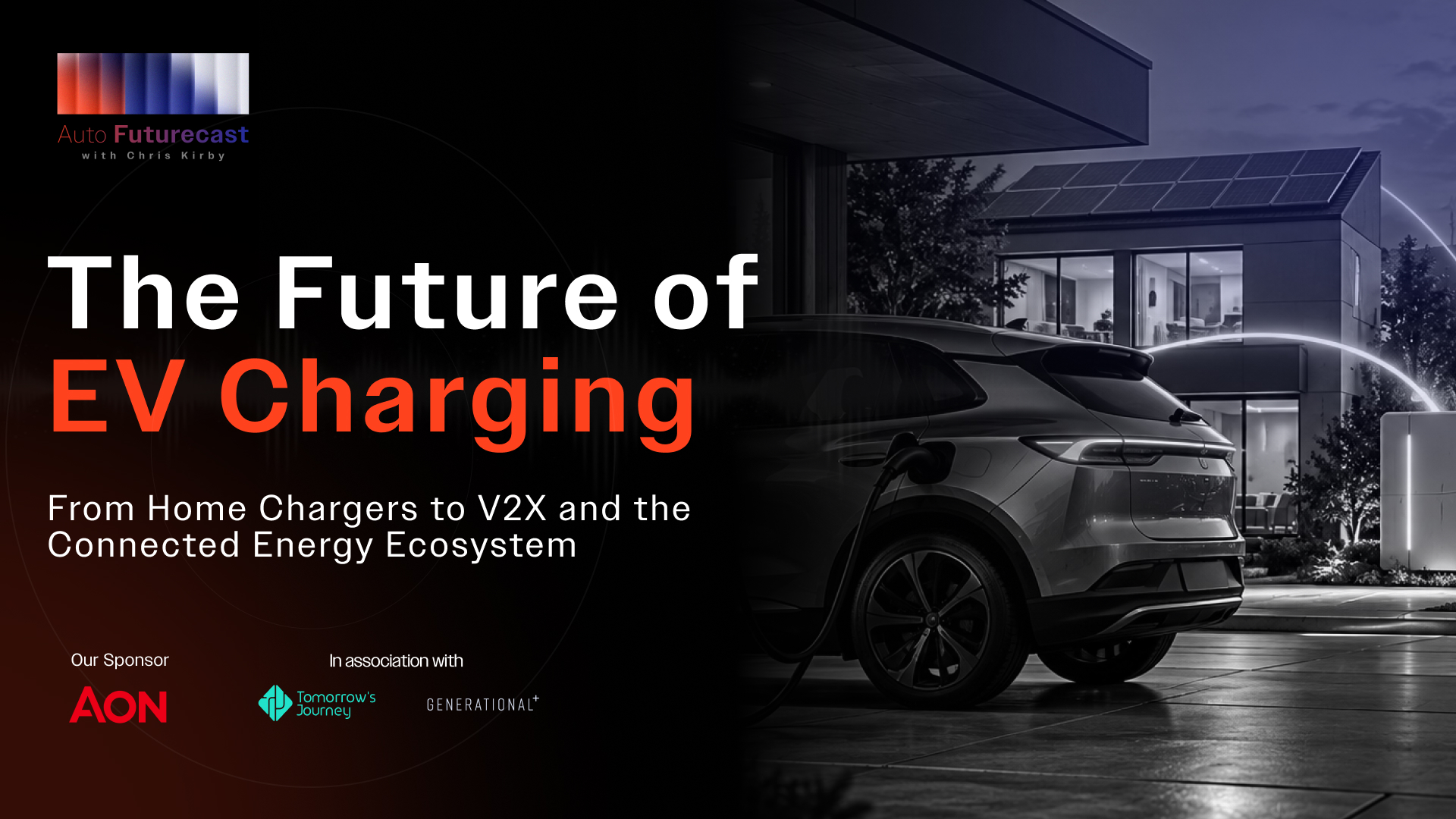
The future of EV charging is no longer just about installing more charging points.
As electric vehicles become increasingly common, the infrastructure around them is evolving too. Home charging is becoming more sophisticated, commercial charging is expanding, and technologies such as vehicle-to-grid (V2G) and vehicle-to-everything (V2X) are beginning to connect electric vehicles with the wider energy system.
But there is another challenge underneath all of this: how do we make increasingly complex technology simple for the people actually using it?
In Episode 7 of Auto Futurecast, Chris Kirby speaks with Anthony Brien, UK Lead at Next Blue, about the changing EV charging landscape, the growth of home and commercial charging, consumer education, V2X, interoperability and the next stage of EV adoption.
Why is EV charging becoming a bigger part of the EV conversation?
Buying an EV is only one part of the transition to electric mobility.
For many drivers, the experience of owning an EV depends heavily on what happens after the vehicle arrives on the driveway. Where will it charge? How quickly? What tariff should the driver use? Is the charger compatible with the vehicle? Will it work with future technology?
These questions are becoming increasingly important as consumers move beyond simply considering whether they want an EV and start thinking about how an EV fits into their everyday lives.
Anthony describes entering an increasingly crowded EV charging market where affordability was improving but reliability and quality remained important considerations. Next Blue's approach has focused on AC charging across domestic and commercial applications while responding to feedback from installers, partners and customers.
That reflects a wider shift in the charging industry: the charger needs to work as part of the customer's overall experience, not simply exist as a piece of hardware.
What is holding back EV charging adoption?
One of the biggest challenges discussed in the episode isn't necessarily technology.
It's understanding.
The EV charging ecosystem can be confusing for someone experiencing it for the first time. AC and DC charging, charging speeds, home tariffs, vehicle compatibility and different charging technologies all create additional decisions for consumers.
Anthony argues that there is still considerable work to do around education, including at the dealership and installer level.
This matters because consumers don't necessarily need to understand every technical detail.
They need to understand what their vehicle requires, what type of charger suits their usage and how charging fits into their daily routine.
For a driver who travels 30 or 40 miles a day, for example, the charging solution required may look very different from that of a driver regularly covering hundreds of miles.
The challenge for the industry is therefore not simply providing more information. It is providing the right information at the right point in the customer journey.
Why does charging reliability matter?
The charger may look like a relatively simple piece of hardware, but its reliability has a direct impact on the ownership experience.
A home charger needs to work consistently. It needs to integrate with relevant energy tariffs and, increasingly, interact with other parts of the home energy system.
For installers and businesses, reliability also affects customer confidence and ongoing support.
This is particularly relevant as the charging market becomes more competitive. Anthony describes Next Blue's emphasis on listening to customers and using their feedback to develop subsequent generations of its products.
The result is a broader lesson for charging infrastructure: cost matters, but so does the quality of the ecosystem surrounding the product.
What role will V2G and V2X play in the future?
This is where the conversation becomes particularly interesting.
V2G, or vehicle-to-grid, and the wider concept of V2X, or vehicle-to-everything, have the potential to change the role of the EV.
Instead of the vehicle simply taking electricity from the grid, bidirectional technology can allow energy to move between the vehicle and other parts of the energy ecosystem.
That could mean the EV interacting with a home, solar generation, batteries, energy management systems or, eventually, the wider grid.
But Anthony points out that being "V2X ready" is about more than hardware. The software and integrations behind the system are equally important.
That creates a much bigger challenge.
How do you make the connected energy ecosystem work?
Imagine a home with:
- An electric vehicle
- A bidirectional charger
- Solar panels
- A home battery
- An energy management system
- A smart energy tariff
The value of that system depends on those individual components being able to communicate with one another.
As Anthony explains, interoperability between different vehicles, chargers, solar systems, batteries and energy platforms will be critical.
Without that interoperability, consumers risk ending up with a collection of technically advanced products that don't work together effectively.
The future therefore isn't simply about making each component smarter.
It's about making the ecosystem work as one.
Could the EV become part of the home energy system?
Potentially, yes.
One of the ideas explored in the conversation is the changing relationship between the EV and the home.
A vehicle sitting on a driveway for much of the day represents a significant energy storage asset. If the necessary technology and infrastructure are in place, that battery could eventually play a role in how energy is stored and used within the household.
This could become particularly interesting for homes with solar generation.
Instead of simply generating electricity during the day and sending unused energy elsewhere, a connected EV could potentially become another part of the home's energy management strategy.
The technology is still developing, and the episode makes clear that there are important infrastructure, software and interoperability questions to resolve. But the direction of travel points towards a much more integrated relationship between mobility and energy.
How could the second-hand EV market change charging?
Another major development is happening outside the charging industry itself: the growth of the used EV market.
As more EVs enter the second-hand market, consumers have access to electric vehicles at increasingly accessible price points.
That could change the demographics of EV adoption.
For a driver considering a lower-priced used EV, the question may be less about buying the latest technology and more about whether the vehicle works for their actual driving needs.
Range is a good example.
A vehicle with 150 miles of real-world range might be completely adequate for someone who drives 30–50 miles a day and charges at home. For another driver, it may not be enough.
This makes charging infrastructure even more important.
As EV ownership expands into the second-hand market, consumers will need clearer guidance around vehicle range, charging behaviour and total running costs.
What does commercial EV charging look like?
The charging conversation also extends beyond private households.
Commercial applications are becoming increasingly important, particularly as fleets transition towards electric vehicles.
One interesting point raised in the episode is that not every commercial application necessarily requires high-powered DC charging.
For some fleets and lighter commercial use cases, overnight AC charging at 7kW or 22kW may provide the necessary energy at a significantly different infrastructure cost.
Destination charging also creates another opportunity.
Hotels, offices, workplaces and other locations where vehicles naturally spend time can provide charging without requiring drivers to make a separate journey to a charging station.
That creates a broader principle for fleet electrification:
Charging infrastructure should be designed around how the vehicle is actually used.
What is next for the EV charging industry?
The next phase of the market is likely to involve greater variety rather than one universal charging solution.
Next Blue is already expanding its product range, including a tethered unit and plans for a broader commercial range, with the company looking to build further on its domestic presence.
At the same time, the wider industry is moving towards more sophisticated energy integration, V2X capabilities and connected charging.
The challenge will be ensuring that all of this progress remains accessible to consumers.
Because the paradox of EV charging is that the technology behind it is becoming more complicated while the experience should become simpler.
Drivers shouldn't have to understand every protocol, software integration or energy-market mechanism.
They should be able to plug in, charge their vehicle and increasingly benefit from the wider energy ecosystem without needing to become energy experts.
What does the future of EV charging really look like?
The future of EV charging isn't simply about more chargers.
It is about better-connected chargers.
The industry is moving towards an ecosystem where vehicles, charging infrastructure, homes, businesses, energy providers and the grid can interact more intelligently.
For that to happen, several pieces need to come together:
Better education so consumers understand their options.
Better interoperability so different technologies can communicate.
Better infrastructure so charging is available where and when it is needed.
Better software so the increasingly complex system remains simple to use.
And ultimately, better integration between mobility and energy.
That's what makes the next stage of EV charging so interesting. The charger may have started as a way to put energy into a car, but its future role could be much bigger.
It could become one of the key connections between the vehicle, the home and the energy system.
Key Takeaways
- EV charging is moving beyond basic vehicle charging towards a connected energy ecosystem.
- Consumer education remains a significant part of the EV transition.
- Reliability and affordability need to develop together.
- V2G and V2X could change how EVs interact with homes and energy systems.
- Interoperability between vehicles, chargers, solar, batteries and energy platforms will be increasingly important.
- The growing second-hand EV market could broaden access to electric mobility.
- Commercial and fleet charging needs to reflect different vehicle use cases.
- The next generation of charging will need to be more intelligent without becoming more complicated for the customer.
Watch Episode 7 of Auto Futurecast
In this episode, Chris Kirby and Anthony Brien explore the future of EV charging, the rise of V2X, home energy integration, commercial charging and what the next phase of EV adoption could mean for drivers and the wider automotive industry.
🎙️ Watch the full episode and join the conversation.
Sponsored by Aon, in association with Tomorrow’s Journey & Generational.