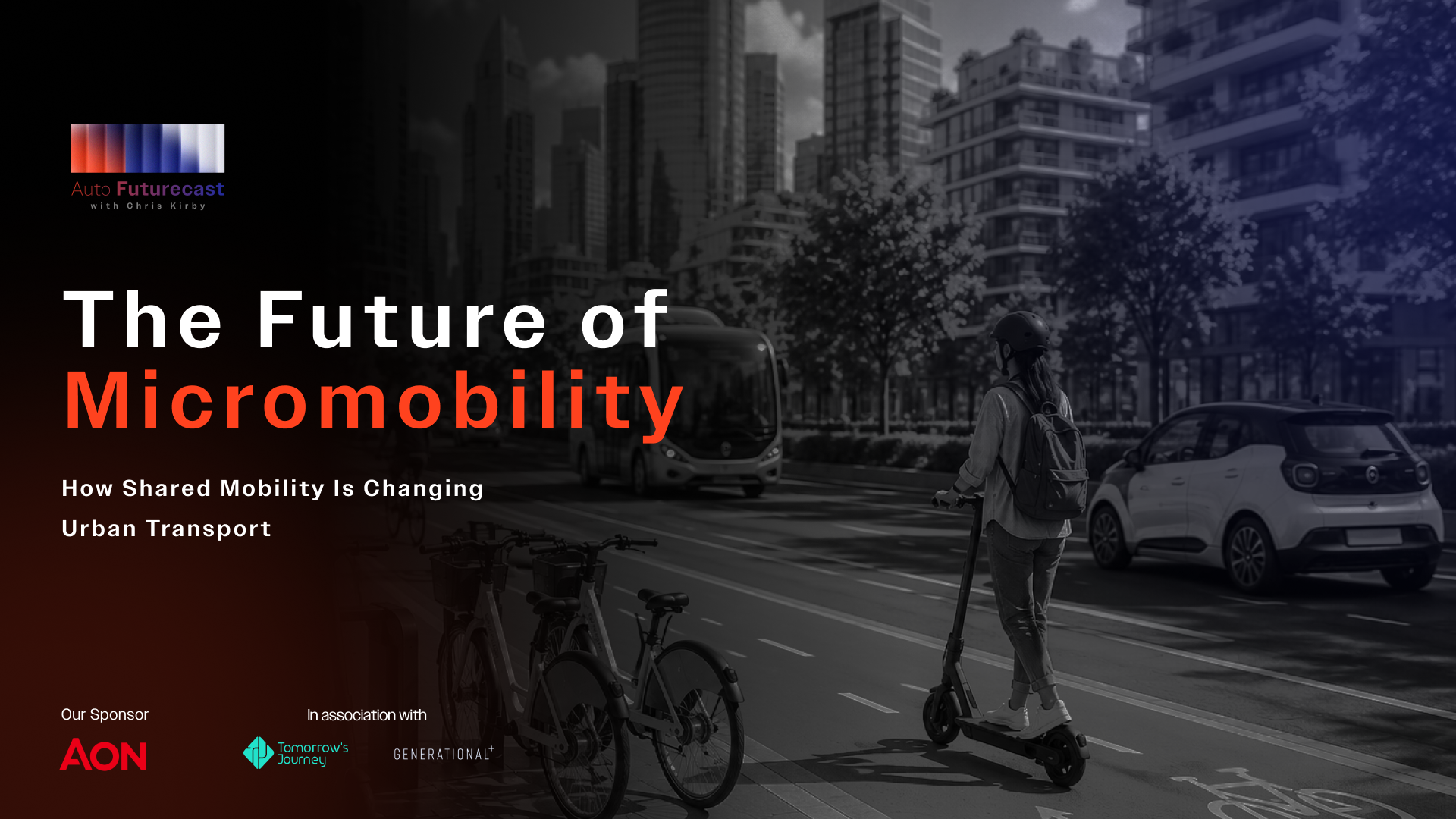
The Future of Micromobility: How Shared Mobility Is Changing Urban Transport
Micromobility is becoming an increasingly important part of the urban transport conversation. Shared bikes and e-bikes are no longer simply a novelty or an alternative for occasional journeys. In cities such as London, they are becoming part of how people commute, connect with public transport and move around their local areas.
But scaling shared mobility successfully is more complicated than putting more bikes on the streets. It requires the right infrastructure, effective fleet management, appropriate regulation, collaboration with local authorities and a clear approach to how limited urban space is allocated.
In Episode 5 of Auto Futurecast Season 2, Chris Kirby is joined by Caroline Seton, Co-Founder & Director at Forest, to explore the realities of operating shared mobility at scale and what the future could look like for micromobility and urban transport.
The conversation covers everything from shared bike usage and fleet management to parking, kerbside space, safety, transport policy and the relationship between micromobility and existing public transport.
What is micromobility and why does it matter for cities?
Micromobility generally refers to smaller, lightweight forms of transport used for shorter urban journeys. In the context of this conversation, that includes shared bikes and e-bikes and their role within the wider transport system.
The important shift is that micromobility is increasingly being considered as part of the overall urban mobility ecosystem, rather than as a standalone transport category.
For cities, that creates an opportunity to provide people with more options for getting around while connecting different parts of the transport network. A shared bike can, for example, become part of a wider journey involving a train or Tube rather than replacing public transport altogether.
Caroline highlights this broader view during the conversation, describing the need for "that holistic look at all the different shared modes" and their integration with traditionaltransport options such as train and Tube stations. The objective, she explains, is to create "a transport system that works for all use cases."
That perspective is important because the future of urban mobility is unlikely to be defined by a single mode. Instead, cities will need to understand how micromobility, public transport, walking, cycling and other transport options can work together.
How is shared mobility changing urban transport?
Shared mobility has changed the way some people think about vehicle ownership and urban journeys. Instead of every journey requiring access to a privately owned vehicle, shared transport can provide another option when and where it is needed.
The Forest experience discussed in the episode provides a useful example of this evolution.
The conversation explores how shared bikes have become part of everyday journeys and how usage patterns can change depending on weather, events and the movement of people around a city.
This creates a different type of mobility challenge. A shared bike fleet has to be available in the right place, at the right time and in the right condition.
That means the customer-facing experience is only one part of the equation. Behind every shared bike is an operational system involving fleet management, maintenance, battery management, repositioning and data.
From occasional alternative to everyday transport option
One of the most significant developments in shared mobility is the increasing normalisation of bike sharing.
As usage grows, operators need to think less like a traditional transport provider and more like a technology-enabled fleet operation. Availability, reliability and safety become central to whether people continue to use the service.
This also means cities need to think about shared mobility differently. If shared bikes are being used as part of everyday journeys, the infrastructure supporting them needs to reflect that role.
What does it take to manage a shared bike fleet?
One of the most practical parts of the Auto Futurecast conversation focuses on fleet management.
From the outside, a shared bike service can appear relatively simple: find a bike, unlock it, ride it and leave it. Behind the scenes, however, operators need to constantly monitor where vehicles are, whether they are charged, whether they are safe to use and whether they are positioned where demand is likely to occur.
Weather and unexpected events can significantly affect demand.
Caroline explains that operators may need to relocate bikes when there is an oversupply in a particular location, such as around a festival or the London Marathon. Forest also uses teams known as Forest Guardians to tidy bikes, carry out basic safety checks and perform certain maintenance tasks on the street.
This makes shared mobility a sophisticated operational challenge.
How technology supports shared mobility operations
Forest has developed its own operations app to help manage this complexity.
According to Caroline, the system allows the company to track and measure operational activity, allocate tasks to Guardians, manage maintenance and battery changes, and plan routes more efficiently.
This is a useful example of how fleet technology and data can influence the performance of a shared mobility service.
Rather than simply reacting when a bike needs attention, operational data can help identify tasks and determine how teams should move around a city efficiently.
The result is a model that has similarities with other fleet-based industries: vehicles need to be monitored, maintained, repositioned and kept available for customers.
Why is infrastructure so important for micromobility?
Infrastructure is one of the biggest factors influencing the future of urban mobility.
It is not enough for cities to have demand for shared bikes. There needs to be somewhere for those bikes to operate and, crucially, somewhere for users to park them responsibly.
This becomes particularly challenging in dense urban environments where road space and kerbside space are already under pressure.
The issue isn't simply about creating more cycling infrastructure. It is also about deciding how public space should be allocated between different transport modes.
How does parking affect shared mobility?
Parking is a recurring challenge for shared mobility operators because different areas can have different rules and requirements.
Caroline discusses the complexity of operating across London's boroughs, explaining that each borough has its own procurement process and can have different approaches to parking and service requirements.
For users, that can create an additional layer of complexity.
A person travelling through London may cross a borough boundary without realising that the rules around where they can leave a bike have changed.
As Caroline explains, "the user doesn't typically know when they've crossed borough boundaries." Different parking requirements can therefore create confusion about whether a bike is being left in an appropriate location.
This highlights a wider issue for cities: regulation needs to be understandable not only to operators, but also to the people actually using these services.
The kerbside challenge
The discussion around parking leads to a much bigger question: who gets access to urban space?
Roads and kerbs are being asked to accommodate an increasingly diverse set of needs, including cars, buses, bicycles, pedestrians, deliveries, parking and shared mobility.
Caroline argues that cities need to think more carefully about how public space is allocated as demand for active travel grows.
Her view is clear: "we need to think about the way that public space is allocated" so that cities can better support active travel and respond to changing demand.
This could become one of the defining challenges for future cities.
How can micromobility integrate with public transport?
One of the strongest opportunities for shared mobility is its ability to complement existing public transport.
Rather than thinking about bikes, buses and trains as competing services, cities can consider how they can work together.
A shared bike can provide a connection between a residential area and a station, or between a station and a final destination. This makes first-mile and last-mile connectivity an important part of the micromobility conversation.
Caroline describes the importance of integrating different shared modes with traditional transport infrastructure, including train and Tube stations.
Why transport integration matters
A connected transport system gives people more flexibility in how they travel.
For urban planners, the opportunity is to design a system where different modes support each other rather than operating independently.
That requires coordination between operators, local authorities, infrastructure providers and public transport networks.
It also requires the physical infrastructure to support those connections. If someone arrives at a station but cannot easily find a bike or a suitable place to park one at their destination, the potential benefits of integration are reduced.
What role does regulation play in the future of micromobility?
Regulation is another major theme in the conversation.
Micromobility has developed relatively quickly, while the policy frameworks surrounding new transport models can take considerably longer to evolve.
The challenge is finding the right balance between encouraging innovation and ensuring that services operate safely and responsibly.
For operators, regulation can affect everything from where bikes can operate and park to the requirements placed on businesses working with local authorities.
For users, clear and consistent rules can make the experience easier to understand.
Why collaboration between cities and operators matters
The London example demonstrates why collaboration is particularly important.
Forest operates across multiple boroughs, each with its own processes and requirements. Caroline explains that the company started operating in two boroughs and has expanded to 20, giving it the largest operating area of any London operator at the time of the conversation.
That scale creates both opportunities and challenges.
Operators need to understand local requirements, while cities need to understand how their policies affect the practical operation of shared mobility.
The future of micromobility will therefore depend not just on better vehicles or better apps, but on better collaboration between mobility operators, policymakers and cities.
What are the safety and operational challenges of shared mobility?
As with any transport system, safety is an important consideration.
The episode explores issues including vandalism, rogue behaviour, maintenance and the operational processes required to keep shared bikes in good condition.
Forest's Guardian teams provide regular touch points with vehicles, carrying out basic safety checks and maintenance tasks and swapping batteries when required.
Technology also plays a role in managing these processes.
At the same time, Caroline points out that the industry is still relatively young and needs continued investment in technology, safety and hardware.
This creates an important commercial consideration: improving safety and reliability requires investment, but operators also need to maintain a viable business model.
Is shared mobility commercially sustainable?
The future of shared mobility isn't only a question of adoption. It is also a question of economics.
Operators need to balance infrastructure, fleet operations, maintenance, insurance, technology and staffing costs against what customers are willing and able to pay.
Caroline describes this as a delicate balance, particularly as the industry continues to develop and operators invest in new technology and safety improvements.
For shared mobility to become a durable part of urban transport, the business model needs to work for multiple stakeholders: users, operators, cities and communities.
That means commercial sustainability and environmental sustainability need to be considered together.
What does the future of micromobility look like?
Looking ahead, Caroline remains positive about the potential for shared mobility in London and other European cities.
She points to the continued growth of cycling and the development of cycleways as important parts of the wider infrastructure supporting active travel.
But the next stage of growth will require cities to move beyond simply increasing the number of bikes or cycleways.
The bigger question is how urban environments are designed around changing travel behaviour.
The future is about the wider mobility ecosystem
The most important takeaway from the conversation is that micromobility does not exist in isolation.
Its future depends on how effectively it connects with public transport, how cities allocate public space, how regulations evolve and how operators use technology to manage fleets.
As Caroline puts it, the industry needs to continue investing in technology, safety and hardware while finding a sustainable balance between those investments and the cost to users.
That makes the future of micromobility as much a question of urban planning and policy as it is of technology.
Key Takeaways From Caroline Seton's Auto Futurecast Episode
- Shared mobility is becoming part of the wider urban transport ecosystem, rather than operating as a standalone service.
- Micromobility requires sophisticated fleet management, including maintenance, battery management, repositioning and operational data.
- Infrastructure and parking are critical to adoption, particularly as demand for shared bikes grows.
- Kerbside space will become increasingly important as cities balance cars, public transport, active travel, deliveries and shared mobility.
- Transport policy and regulation need to evolve alongside new mobility models to provide clarity for operators and users.
- Public transport integration can increase the value of micromobility, particularly for first- and last-mile journeys.
- Safety and technology require continued investment, creating an important balance between service quality and commercial sustainability.
- The future of urban mobility will depend on integration, collaboration and how effectively different transport modes work together.
What can cities and mobility businesses learn from shared mobility?
The conversation between Chris Kirby and Caroline Seton ultimately points to a broader lesson for the mobility industry.
The future of urban transport won't be determined by one vehicle, one technology or one operator. It will be shaped by the interaction between mobility services, infrastructure, data, policy and the way cities use public space.
For cities, that means thinking beyond individual transport modes and considering how the entire mobility ecosystem works together.
For mobility businesses, it means building services that can operate reliably within increasingly complex urban environments while responding to the needs of users, policymakers and local communities.
And for the wider automotive and mobility industry, it offers a reminder that the definition of mobility continues to expand.
Shared mobility, micromobility, active travel and public transport are becoming increasingly interconnected. The cities that recognise that connection will be better positioned to design transport systems around how people actually move.
Watch Episode 5 of Auto Futurecast
In Episode 5 of Auto Futurecast Season 2, Chris Kirby and Caroline Seton explore the realities of shared mobility, the challenges facing micromobility operators and the changes that could shape the future of urban transport.
🎙️ Watch the full episode and join the conversation.