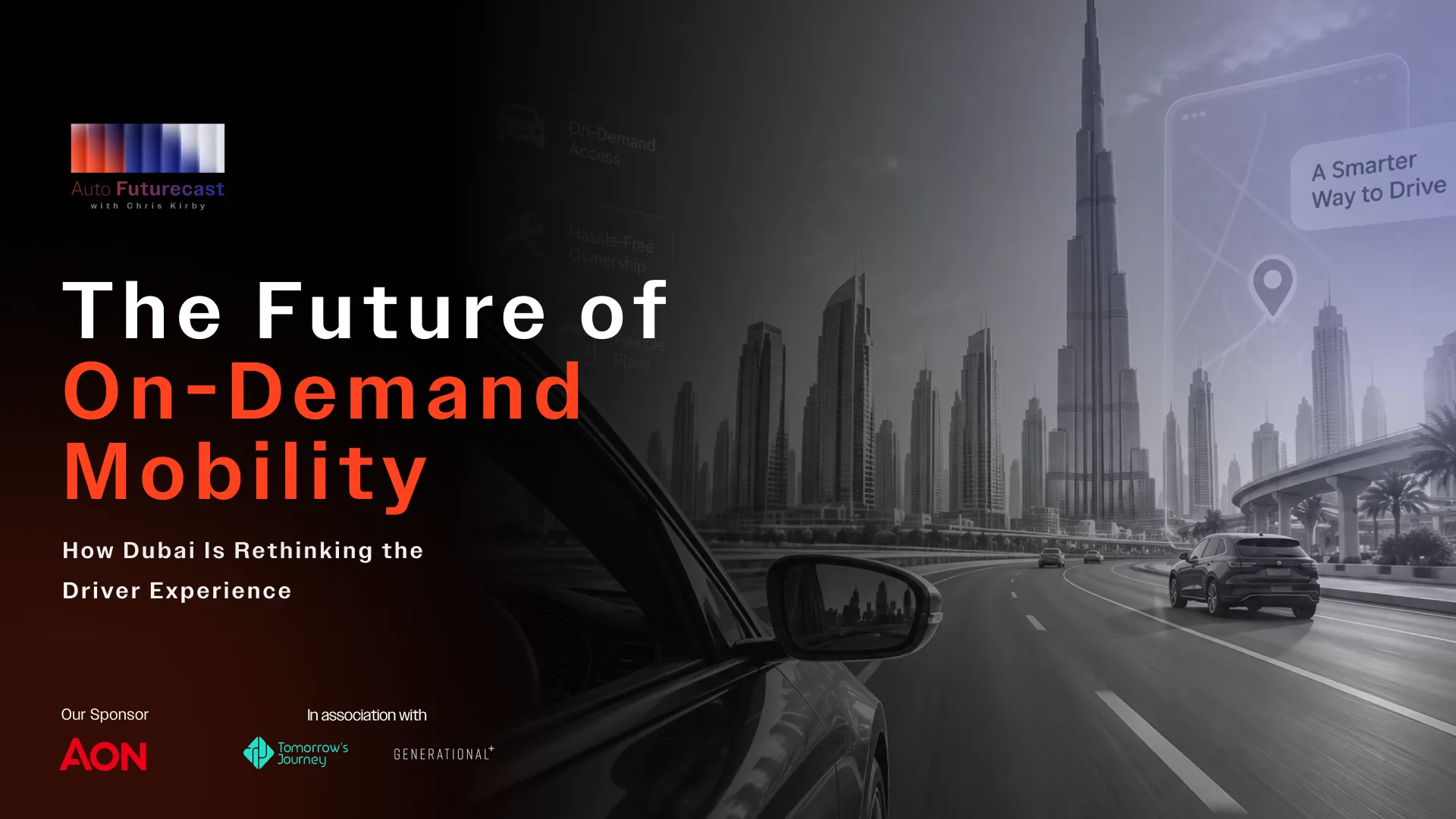
The Future of On-Demand Mobility: How Dubai Is Rethinking the Driver Experience
What does the future of mobility look like when the vehicle isn't the problem, but the experience around it is?
For Episode 6 of Auto Futurecast Season 2, Chris Kirby takes the conversation to Dubai for the first time, joining Lauren Hamilton, Founder of Ride Skipper, to explore a different side of mobility: on-demand drivers, family transportation and the changing expectations around convenience, safety and trust.
Lauren's journey into mobility began with a personal problem. After having her son and temporarily being unable to drive, she found that existing services could get her from A to B, but didn't consistently provide the level of safety, communication and service she wanted. That experience became the starting point for Ride Skipper.
Today, the company provides on-demand drivers who drive customers in their own vehicles, supporting school runs, airport transfers, family journeys, evenings out and other everyday transport needs.
The result is a mobility model that sits somewhere between traditional chauffeur services and ride-hailing - and it raises some interesting questions about where the next generation of mobility services could come from.
What Is an On-Demand Driver Service?
Unlike conventional ride-hailing, where the customer travels in a vehicle provided by the platform or operator, an on-demand driver service puts the driver into the customer's own car.
That distinction matters.
For families, using their own vehicle means retaining the car seat, personal belongings and familiarity of their own car while outsourcing the driving itself. For other customers, the appeal can be simply having a trusted driver available when they need one without employing a full-time chauffeur.
Ride Skipper describes this as an on-demand driver model: customers don't need a driver sitting around all day. The driver is available when the journey requires them.
This creates potential use cases well beyond the traditional school run.
How does on-demand driving work?
Ride Skipper's operating model involves more logistics than a conventional ride-hailing service. Its drivers are transported between customers using vehicles owned by the business, meaning the company has to coordinate both the driver's movements and the customer's vehicle.
That operational layer is one of the biggest challenges of the model.
As Lauren explains, much of the process has historically been handled manually, creating a technology and scalability challenge as the business grows.
The lesson is broader than Ride Skipper: mobility services that look simple from the customer's perspective can have highly complex operational systems behind them.
Why Is Family Mobility Such an Important Use Case?
Family transportation is one of Ride Skipper's biggest areas of demand.
School runs are an obvious example. Parents may need someone to take children to school in the morning and bring them home in the afternoon, while both parents are working.
But the same requirement appears throughout the day.
Drivers can support airport journeys, activities, appointments and other family logistics. For parents, the value isn't simply transportation - it is removing some of the life administration that comes with coordinating work, childcare and travel.
The airport journey provides another example. Lauren describes how getting a young child to the airport can be more stressful than the flight itself, particularly when a family doesn't want to leave its own vehicle parked at the airport or rely on an unfamiliar taxi and car seat.
This points towards a wider shift in mobility.
Consumers don't necessarily want another transportation option. They want less friction around the journey they already have to make.
Why Trust and Safety Matter in Family Transportation
When mobility involves children, the definition of a good service changes.
Price and convenience still matter, but trust, safety and consistency become fundamental.
Lauren says Ride Skipper's recruitment process is intentionally detailed, with the company selecting drivers against high standards because parents need confidence in who is driving their children. The company's drivers are employed on a fixed income rather than being paid per journey, which Lauren says helps create a calmer and more consistent customer experience.
This also explains why Ride Skipper has deliberately avoided simply replicating a gig-economy model.
The business is built around a relationship between the customer, driver and company. For a parent handing over responsibility for their child, that relationship can be more important than the speed of the booking.
Can Technology Scale a Highly Personal Mobility Service?
One of the most interesting tensions in the conversation is the role of technology.
Ride Skipper has clear opportunities to digitise its operations. Driver allocation, routing, scheduling and logistics all create potential areas for technology to improve efficiency.
But Lauren also argues that not everything should be automated.
Because trust is central to the family segment, there are situations where customers still want to speak to a person rather than interact entirely with an automated system.
This creates an important question for mobility businesses adopting AI:
What should mobility companies automate and what should remain human?
The answer may not be to digitise every interaction.
Instead, technology can take care of repetitive operational complexity while people remain involved where judgement, reassurance and trust matter most.
That balance could become increasingly important as AI becomes more embedded in mobility platforms.
What Makes Dubai's Mobility Market Different?
Dubai provides a particularly interesting environment for this type of service.
Being driven is already relatively familiar across parts of the UAE, while the city's transport ecosystem creates different mobility expectations from many European markets.
Ride Skipper sits between traditional chauffeur services and ride-hailing. Customers can access a professional driver without needing to employ one full-time.
The model can also respond to some of the practical challenges of car ownership in Dubai, including parking and the responsibility of driving everywhere.
As Chris discusses in the episode, owning a car isn't necessarily the difficult part. What you do with it - where you park it, who drives it and how you get home after an evening out - can be.
This is an important distinction when thinking about mobility innovation.
The biggest opportunity isn't always creating a replacement for the car.
Sometimes it is changing the relationship people have with the car they already own.
What Are the Biggest Operational Challenges for On-Demand Drivers?
The business model creates several operational challenges.
Driver logistics
A conventional ride-hailing driver generally takes their own vehicle to a customer and then continues to another job.
An on-demand driver service is different.
The driver needs to arrive at the customer's vehicle, complete the journey and then be repositioned for the next booking. That creates a more complex logistics problem, particularly as the number of customers and journeys increases.
Insurance
Insurance is another important consideration.
Lauren explains that in many Gulf countries, insurance is attached to the vehicle rather than the individual driver. This makes it possible for an authorised driver to operate the customer's vehicle, but also creates challenges when considering how the model could work in other markets.
Vehicle handover and damage
Trust also extends to the vehicle itself.
Ride Skipper drivers record 360-degree video of vehicles before and after journeys, creating a record of the vehicle's condition. The company also supports customers through the insurance process if an incident occurs.
These processes may seem operationally small, but they are critical to making customers comfortable with someone else driving their personal vehicle.
Can Mobility Innovation Be About Making Existing Cars Work Better?
The conversation challenges a common assumption about mobility innovation.
Much of the automotive industry's future-focused discussion centres around electric vehicles, autonomous driving, connected vehicles and new vehicle ownership models.
Ride Skipper approaches the problem from a different direction.
The car already exists.
The infrastructure already exists.
The customer already owns the vehicle.
The innovation is in the service surrounding the vehicle.
That opens up an interesting category of mobility innovation: services that don't necessarily replace existing transportation infrastructure but make it more convenient, flexible and usable.
What Does It Take to Build a Mobility Startup in Dubai?
The episode also explores what happens behind the product.
Lauren describes the founder experience as highly demanding, particularly when the business is responsible for a growing team. Ride Skipper has grown to 35 drivers in two years, while Lauren says the responsibility of meeting payroll, managing investment and making decisions about growth can make startup life all-consuming.
Fundraising creates another challenge.
Lauren discusses the importance of finding investors who understand the business model and whose expectations align with the company's values. A key question is whether founders should pitch an enormous future valuation and hyper-growth story or focus on building a strong business with realistic economics.
For mobility startups, this is particularly relevant because operational businesses can require very different economics from pure software companies.
People, vehicles, insurance, logistics and local regulations all matter.
What Could the Future of On-Demand Mobility Look Like?
The Ride Skipper model raises a broader question about the future of mobility services.
As cities become more expensive and congested, and as people's working and family lives become increasingly complex, there may be growing value in services that remove friction rather than simply add another way to travel.
On-demand drivers could form part of that wider ecosystem.
The model could potentially support families, businesses, travellers and customers who want the convenience of a driver without the commitment of employing one permanently.
But scaling it requires more than demand.
It requires the right technology, insurance framework, employment model, operational infrastructure and economics.
And perhaps most importantly, it requires understanding which parts of mobility people actually want technology to change.
Key Takeaways From Lauren Hamilton on the Future of Mobility
- On-demand driving creates an alternative to traditional ride-hailing and full-time chauffeur services.
- Family mobility is a major use case, particularly for school runs and everyday childcare logistics.
- Trust and safety are central when customers are putting their children or personal vehicles in someone else's hands.
- Technology can improve operational scalability, but not every customer interaction needs to be automated.
- Dubai's mobility environment creates different opportunities from many European markets.
- Insurance and driver logistics are significant considerations for businesses operating in this space.
- Mobility innovation doesn't always require a new vehicle - it can come from creating better services around vehicles people already own.
The Bigger Question for Mobility
The conversation with Lauren Hamilton offers a useful reminder that the future of mobility won't necessarily be defined by on